
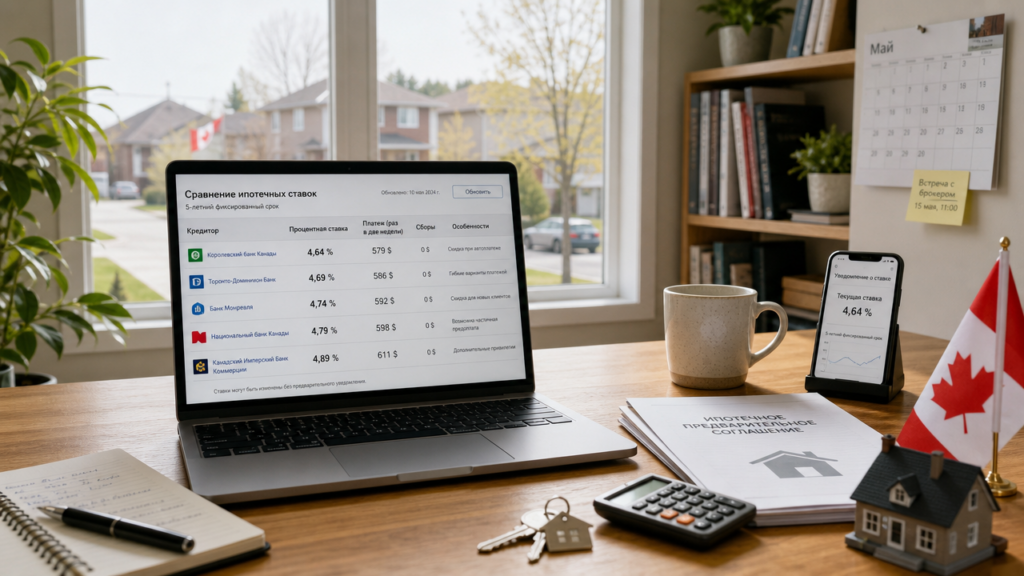
In April 2026, a five-year floating mortgage rate in Canada sits near 3.5% to 4.0%, while mainstream five-year fixed rates range from 3.89% to 4.94%. Borrowers with a down payment below 20% must pay mortgage default insurance, and the minimum down payment jumps at the $500,000 and $1,000,000 price points. Before locking in, compare the penalty formula and rate hold period, because an advertised rate can hide expensive exit conditions.
Mortgage Rate in Canada: Fixed Versus Variable in 2026
Floating five-year rates in April 2026 are lower than fixed rates, but both are rising. Global instability, including conflict in the Middle East, has pushed bond yields and inflation upward, which lifts fixed mortgage pricing. Banks are also trimming discounts on floating rates, so the spread between a 3.8% variable quote and a 4.6% fixed quote may narrow quickly.
A five-year fixed rate offers a stable monthly payment for the entire term, which appeals to borrowers who cannot absorb a sudden increase. A variable rate tied to prime can start lower, but the payment or amortization length can shift if the lender raises prime. For a $500,000 mortgage, a 0.5 percentage point increase adds roughly $208 per month in interest before any principal adjustment.
Down Payment and Mortgage Default Insurance Tiers
The minimum down payment depends on the purchase price, and the mortgage default insurance rule creates a hard threshold at 20% equity.
| Purchase price | Minimum down payment | Mortgage default insurance |
|---|---|---|
| Under $500,000 | 5% of purchase price | Required if down payment is under 20% |
| $500,000 to $1,000,000 | 5% of first $500,000 plus 10% of remainder | Required if down payment is under 20% |
| Over $1,000,000 | 20% of purchase price | Not available, conventional loan required |
| New immigrant without credit history | 35% often required | Depends on lender and loan-to-value |
For an $800,000 purchase, the minimum down payment is $25,000 on the first $500,000 plus $30,000 on the remaining $300,000, for a total of $55,000. That equals 6.875% of the purchase price and triggers mortgage default insurance, because the down payment is under 20%. Mortgage default insurers charge a premium that protects the lender, not the borrower.
Qualification Ratios and Income
Lenders use gross debt service (GDS) and total debt service (TDS) ratios. The GDS ceiling is 32% of gross income, and the TDS ceiling is 40%; a strong credit score can increase the borrowing limit by 3% to 6%. For a household earning $100,000 per year, a 32% GDS allows $32,000 in annual housing costs, or about $2,667 per month for principal, interest, property tax, and heat.
TDS adds credit card, car loan, or line of credit payments to the housing amount. If the same $100,000 household carries $600 per month in other debt, the 40% TDS cap allows $3,333 in total monthly debt payments, leaving $2,733 for housing. Self-employed borrowers face a higher bar and may need a larger down payment to qualify.
Term, Amortization, and Refinancing
A mortgage term is the contract length, often five years in Canada; the amortization period is the total payoff timeline, commonly 25 to 30 years. At the end of each term, the borrower renews with the same lender or refinances to switch lenders and improve the rate or terms before the loan is fully repaid. The borrowed amount is the principal, and each regular payment combines principal and interest.
Refinancing can make sense when rates drop, but the penalty on a fixed mortgage can erase the savings. Ask the lender to confirm the exact interest-rate differential formula, any other charges, and the available prepayment allowance before signing.
Lender Channels and Rate Negotiation
A mortgage agent advocates for the borrower, while specialized lenders may offer better terms for self-employed or credit-damaged clients. First-time buyers can struggle to qualify with standard banks when they have low credit scores, which makes an agent or specialized lender more relevant. First-time buyers in Toronto face tighter qualification after government rule changes.
Down payment funds must sit in a personal account for at least 90 days before closing. Large gifts or recent deposits may need a paper trail, so transfer the money early. If you are self-employed or a new immigrant without a Canadian credit history, plan for a larger down payment. New immigrants without a credit history may need as much as 35% unless a lender offers different terms.
Before Locking In
Request a written rate hold when you are shopping for a home. Confirm whether the hold applies to fixed, variable, or both, because some promotions only protect the fixed quote. Compare the payment impact of a 0.5% rise on variable, then decide whether the fixed premium is justified.
For most borrowers in 2026, the safer choice is the rate structure that matches their timeline and cash buffer, not the lowest printed number. A five-year fixed mortgage rate in Canada near 4.5% may be worth the premium if a 0.5% rate increase would break the monthly budget. A variable rate near 3.6% may work for borrowers who can absorb a payment increase of roughly $200 per month on a $500,000 balance. Run the numbers with a pre-approval and a mortgage agent before locking in.